9 – 3 vote. Dissents are the new forward guidance.
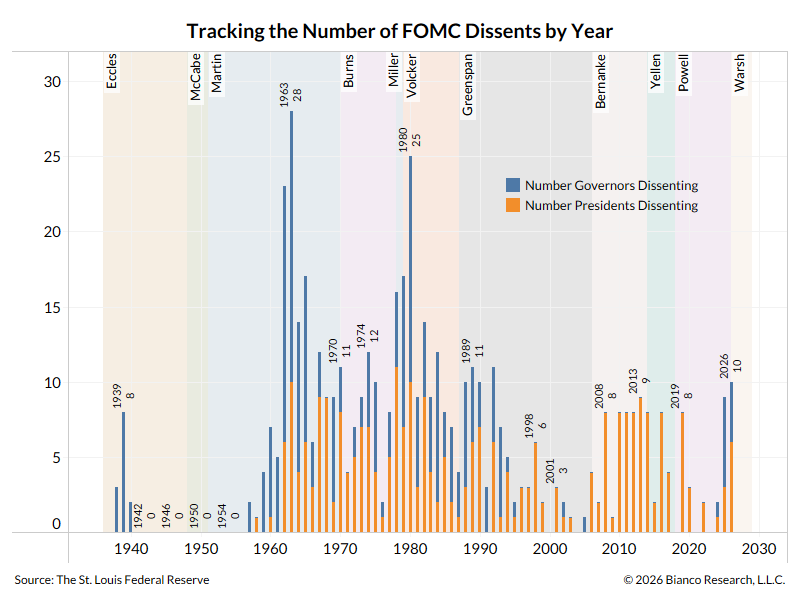
I think when we get to the end of the Warsh term as Fed Chairman, we’re going to see a vast majority of the meetings were 11-1 or 12-0 votes. But when they were getting set to change policy, dissents were your forward guidance to tell you things were going to go a different direction.
What Changed?
Bob Michael of JP Morgan asked what changed. He didn’t understand why the Fed hiked rates because the data didn’t really move that much from June, when we had a 12-0 vote.
What changed is the way that the Fed operates. It’s no longer the chairman dictating and everybody doing what he tells them. They are now independent, and this hawkishness was always there; this desire to raise rates was always there. It was just not allowed to be expressed or acted on. Now it is. That’s what’s changed.
Bianco Research: On the idea that Fed meetings are now “good family fights” and dissents could be the new forward guidance…2026 has already seen 10 dissents, with three meetings left to go. If we get a couple dissents at the next meeting, which seems likely regardless of whether they hike, it will be the highest total since the early 1980s.
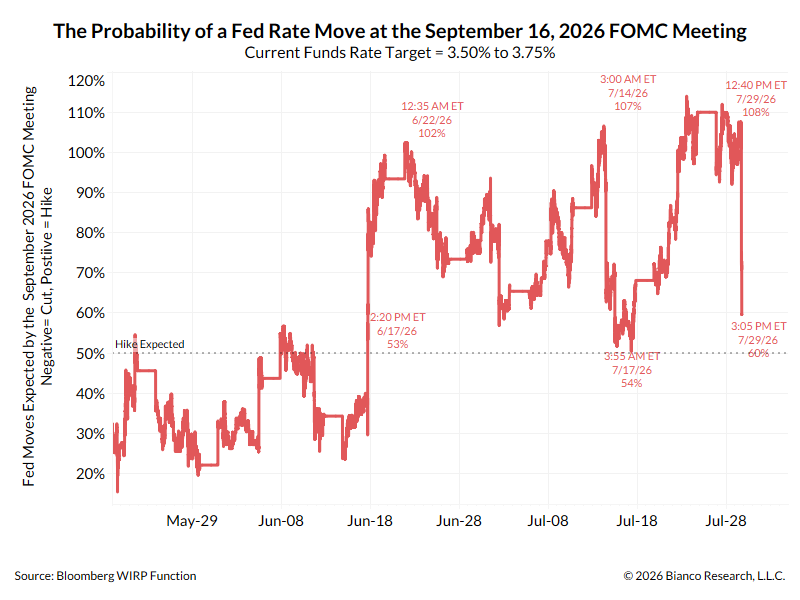
Jim Bianco: Note that the July probabilities NEVER traded above 50% for a hike. They peaked at 40% a few days ago.
Conversely, the probabilities for a September hike have not been BELOW 50% since June 17 (May CPI).
In the Media: Jim Bianco on the Fed’s New Era: Get Used to Higher Interest Rates
On Deck
PCE Price Index will be released tomorrow, Thursday, 7/30/26
Notable Tech Earnings tomorrow, Thursday, 7/30/26: Apple and Amazon (after the close)
Next Week: Quarterly Refunding Announcement on Wednesday, 8/5/26
Upcoming US Treasury Supply
Intraday Commentary From Jim Bianco
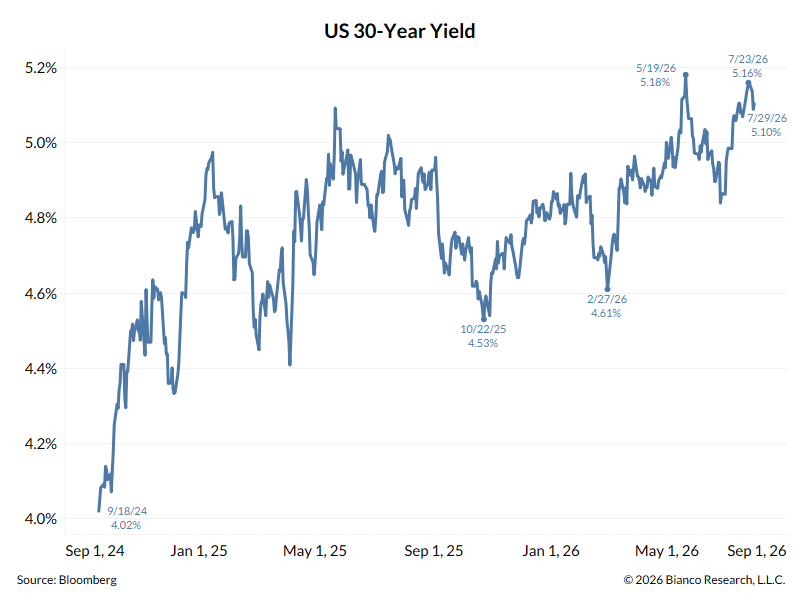
The chart below starts on Sept 18, 2024, the FOMC meeting at which they kicked off the rate-cutting cycle with a 50 bps move. 30-yr yields went straight up (I would argue in response to that cut) and, on May 19, 2026, hit a 19-year high of 5.18%.
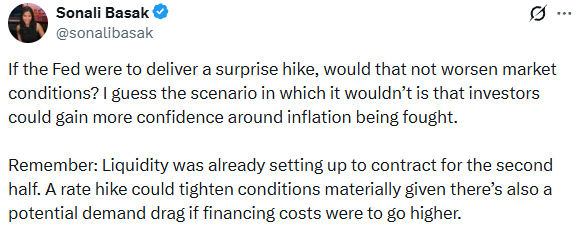
I continue to argue that the problem is that the Fed has not been taking the inflation “problem” seriously, and that the bond market has been rejecting its easy policy. So, a surprise hike might “fix” the bond market rather than worsen it.
The Wall Street adage “bond investors can stop panicking when the Fed starts panicking” applies.
A little Fed-driven panic about inflation might calm bond investors. Holding steady and the yield uptrend below will just continue until they do “choose” (Warsh’s word) to deal with inflation.
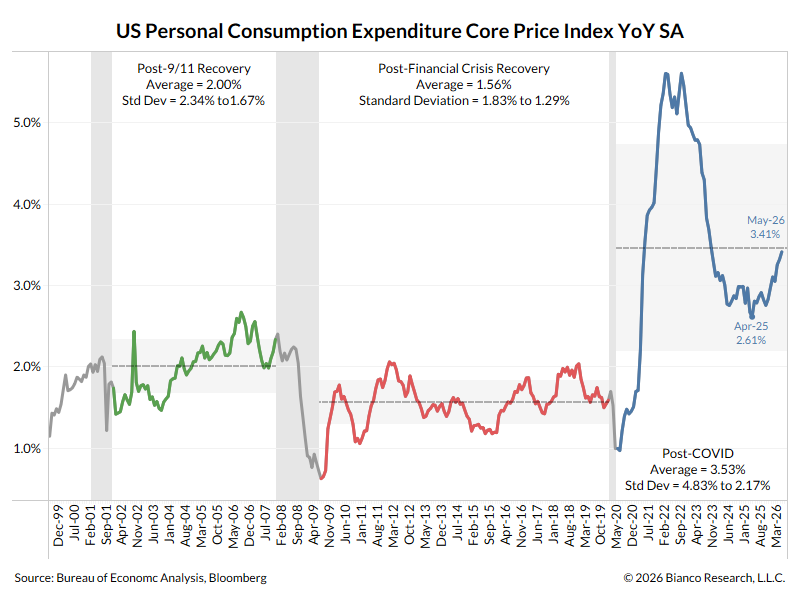
Core PCE removes food and energy (oil) and is the Fed’s favorite inflation measure. It is 80 bps higher than in April 2025.
The post-COVID average and std dev (blue) “step-functioned” higher than the previous two cycles (red and green). We are in a new higher inflation regime post-COVID. The era of sub-2% inflation ended six years ago; that was the previous cycle.
So, in this environment, don’t be surprised that when the Fed cuts rates, the 30-year yield goes straight up and is a few basis points from a 19-year high (post above).
Warsh said, “Inflation is a choice.” If the Fed “chooses” to do something about it, then the bond yields calm down.
Commodities
Gold increased to $4,106.48 an ounce [76% of its recent high of $5,417 an ounce on 1/28/26]
Silver increased to $59.03 an ounce [50% of its recent high of $116.70 an an ounce on 1/28/26]
Copper decreased to 627.35 [94% of its recent high of 667 on 6/2/26]